
by A2 Dental Mallorca | Apr 25, 2025 | Sin categoría
Dental implants have revolutionised modern dentistry, allowing patients to safely and effectively restore their smile and chewing function. At A2 Dental Mallorca, Dr Alberto Rico, a specialist in Advanced Oral Implantology trained at the prestigious New York University (NYU) and with experience at the Bränemark Osseointegration Centre, answers the most frequently asked questions about this treatment.
What exactly are dental implants and why are they such an effective solution?
Dental implants are small titanium structures that act as the root of a natural tooth. They are inserted into the jawbone and, once integrated, support a fixed prosthesis that replaces the missing tooth. They are the best alternative for restoring the function and aesthetics of the smile without affecting adjacent teeth, as traditional bridges do.
How long does it take for an implant to fully integrate into the bone?
The osseointegration period varies depending on the patient, the type of bone (bone density), and whether any additional bone regeneration treatment was required. It generally ranges between 3 and 6 months. However, thanks to advances in immediate loading, in many cases it is possible to place a fixed provisional tooth (or even a full arch) on the same day as the implant, allowing patients to regain their smile straight away and maintain their confidence throughout the process.
What is the “Implant and tooth in one day” technique?
This innovative technique, known as immediate loading, involves placing the implant and a fixed provisional crown during the same appointment. This is possible provided the patient has good bone quality and the implant achieves sufficient stability at the time of placement. At A2 Dental, we always perform a 3D Dental CT scan to determine whether the patient is suitable for this procedure.
Can all patients undergo immediate loading?
Not in all cases. For this technique to be successful, certain criteria must be met, including:
· Good bone quality and quantity to ensure proper implant fixation.
· High primary stability of the implant upon placement.
· Correct management of the soft tissues.
· Occlusal stability in patients with multiple missing teeth.
If these conditions are not met, delayed loading is recommended – meaning waiting for the full osseointegration period before placing the final prosthesis.
What if the patient doesn’t have enough bone for an implant?
In many cases, patients with bone loss can benefit from advanced techniques such as guided bone regeneration or the use of bone grafts. At A2 Dental, we assess each case individually using a 3D scan to determine the most suitable solution, avoiding the need for removable dentures wherever possible.
What is the postoperative period like after a dental implant?
The postoperative recovery is generally quick and minimally uncomfortable. We recommend:
· Following a soft diet for the first few days.
· Avoiding very hot or hard foods.
· Maintaining excellent oral hygiene to prevent infection.
· Avoiding smoking, as it hinders the healing process.
Why choose A2 Dental Mallorca?
At A2 Dental Mallorca, we combine cutting-edge technology with highly personalised care. Our team, led by Dr Alberto Rico, is committed to offering reliable, minimally invasive treatments that prioritise both function and aesthetics. Thanks to our experience and advanced diagnostic tools, we are able to tailor each treatment to the specific needs of the patient, achieving predictable and long-lasting results.
Thinking about restoring your smile with dental implants?
At A2 Dental Mallorca, we offer an initial consultation with our implantology specialist to assess your case and advise you on the best solution. Call us today or book your appointment online. Regain confidence in your smile with the highest quality and safety!

by A2 Dental Mallorca | Mar 7, 2021 | Sin categoría
Halitosis is also known colloquially as “bad breath”. It is defined as unpleasant odors that emanate from the oral cavity. There is a growing social sensitivity about halitosis. Some people may be concerned about its connotations regarding their health and others about its social, personal, work implications, etc.
Factors that cause halitosis include: gastrointestinal tract conditions, lung conditions, use of certain medications, and ingestion of certain foods. However, in 90% of cases, the bad smell originates in the oral cavity itself.
The substances that cause mouth odor are a consequence of bacterial metabolic degradation. These substances are found in the gums, mucous membranes, in saliva and especially on the tongue.
There is an examination to diagnose the origin of the problem of bad breath and also some protocols and reviews to follow in order to treat it.
This protocol includes:
- Professional cleaning
- Oral hygiene instructions with the necessary tools according to the needs of each case.
- The use of specific antimicrobial agents: both toothpaste and mouthwash.
- Periodic reviews
We anticipate a very important tip: the use of the Lingual Scraper. If you want to know more about how to use it correctly, do not hesitate to contact us, our team will be happy to solve any questions you may have.
You can call us on +34 971 201 123
Or contact us here.
by A2 Dental Mallorca | Nov 15, 2020 | Sin categoría
FULL MOUTH REHABILITATION WITH ALL ON FOUR AND ALL ON SIX
In the previous Blog we talked about “All-on-four and all-on-six” dental implant treatments. Now we want to share a patient experience with you…
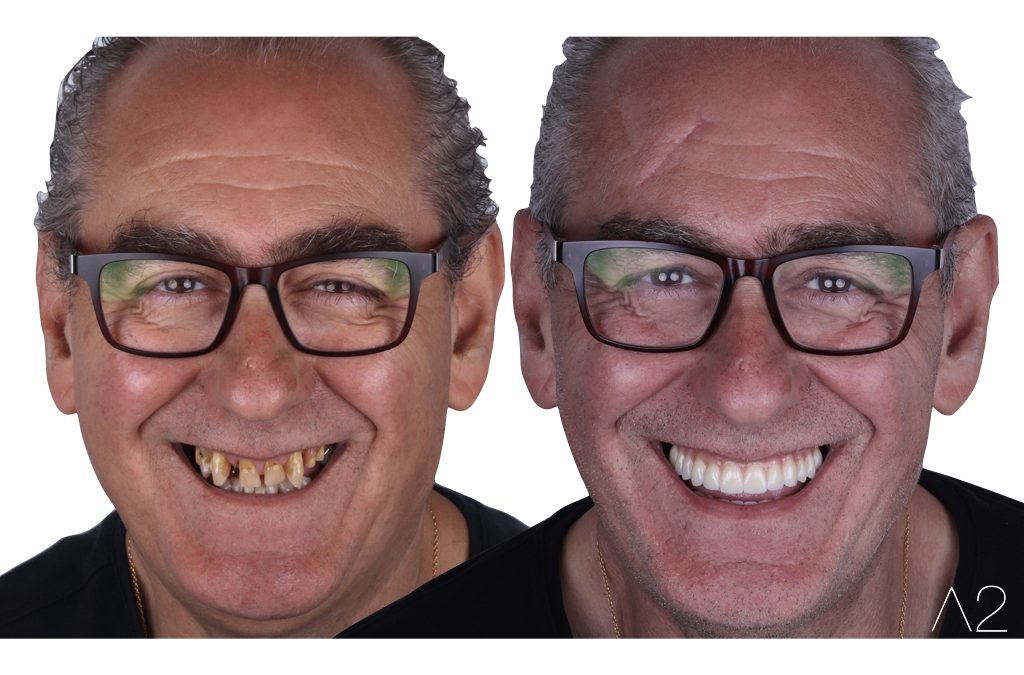
We introduce you to our patient Roberto. He is from Madrid and we had the pleasure of meeting thanks to the recommendations of his friends, who are our patients. When Roberto came to us, his mouth was in very bad condition, with repetitive infections, discomfort when chewing, and generally very poor oral aesthetics.
The teeth that he kept in his mouth were very compromised and did not have a good prognosis, they were not maintainable. For this reason, we proposed to do a “Complete fixed restoration on implants” upper and lower (All-on-four and All-on-six).
Living in Madrid and having to travel to Mallorca for his treatment, we needed to organize everything very well. We made a treatment plan with appointments and times, so that we could all make the most of each trip. We managed to reduce the entire treatment to only 3 trips to Mallorca.
On the first trip:
- We performed a 3D Dental CT scan: to perfectly assess the quantity and quality of available bone and to plan the type of implants which will be ideal for him (their size, in what positions to place them and the possibility of placing the implants at the same time as dental extractions).
- We took photos to do a “DSD” Digital Smile Design, and plan everything before starting any treatment.
- We registered moulds to have study models: which we sent to the laboratory that same day to start making the first set of fixed prostheses that we will place immediately after the surgery.
- We did a deep cleaning (oral-dental hygiene), so that the mouth is in the best possible condition (disinfected and deflated) at the time of surgery.
- The operation was done under Conscious Sedation (monitored by an anesthesiologist at our facilities). The dental extractions were performed and immediate implants were placed at the same time of the extractions.
- We applied Plasma in all the intervened areas to facilitate and accelerate healing.
- Once awake, after the surgery, we took new registers, this time with the implants, and sent them back to the laboratory to be able to finish Roberto’s immediate fixed prostheses that same day.
- Once the laboratory has finished the work, we adjust it in the mouth by fixing the teeth onto the newly placed implants. This is what is known as “immediate loading” or colloquially known as “fixed teeth in a day”.
This way, on Roberto’s first trip, he has already left with the surgery performed and with new fixed teeth, although they are still provisional.
3-4 months after the implant placement (which is the time it takes for the bone to integrate the implants as its own-also known as Osseo-integration), we organize the second trip to A2 Dental.
2nd trip to Mallorca:
- We disconnect the provisional fixed prostheses (upper and lower) to clean and re-evaluate the healing of everything.
- Since the gums are now fully healed, we take new moulds to start fabricating the definite prostheses.
- The laboratory prepared several tests to determine aesthetic parameters, such as: shape, size and color of the teeth, bite, etc.
- The patient returns home with his temporary teeth fixed.
3rd trip:
- With all the information and design that we have planned in the previous visit, the laboratory has been able to finalize the final prostheses.
- On this last trip we were able to place Roberto’s new teeth. Since we operated on him, he has never had to spend a day without teeth.
- He now has an ideal smile due to the planning, design and choice of materials that we used on the prostheses, as you can see in this link:
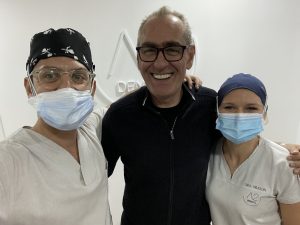
At A2 Dental we are very proud that people have travelled from far to be treated by us and trust us with their mouth.
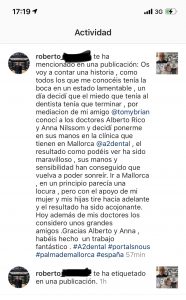
We have explained the technical part of the story, here the story from Roberto’s point of view:
If you want to learn more about some of the aspects described in this blog, we provide the following links:
